FOUR PROFESSORS OBSERVE LUMINOUS FORMATIONS -- STUDENT PHOTOGRAPHS CONFIRM REPEAT VISITS
Texas Tech scientists conduct systematic nightly watch -- Project Blue Book initially classifies case Unknown -- bird explanation disputed by original witnesses
LUBBOCK, TEXAS -- August 1951 -- First reported: August 26, 1951
Date
August 25 -- September 1951 (multiple nights)
Location
Lubbock, Texas -- directly over residential areas and Texas Tech campus
Witnesses
12+ documented across multiple nights including four Texas Tech professors and civilian photographer
Evidence Types
PHOTOGRAPHIC, DOCUMENTARY
Official Explanation
Chordeiles acutipennis (lesser nighthawk) reflecting city lights on their white wing patches (Project Blue Book revised explanation)
Current Status
Original Project Blue Book classification: Unknown. Revised to nighthawk explanation disputed by all four professors.
On the evening of August 25, 1951, four professors from Texas Technological College step outside after dinner and begin talking in the backyard of one of their homes. They are scientists -- a geologist, two engineers, and a meteorologist -- accustomed to observation and description.
At 9:20 p.m., the first formation passes overhead. Eighteen to twenty pale bluish-white lights in a rough semicircle, traveling from north to south at high speed and in complete silence. The formation takes only a few seconds to cross the sky. The men stare at each other. Before any of them speaks, a second formation passes, then a third.
Over the following weeks, the professors establish a systematic sky-watch program. They record times, bearings, angular sizes, and flight characteristics. The formations appear multiple times, sometimes several nights in a row. The objects are luminous -- not reflective -- and travel too fast and too uniformly for bird flight. They take measurements. They file reports.
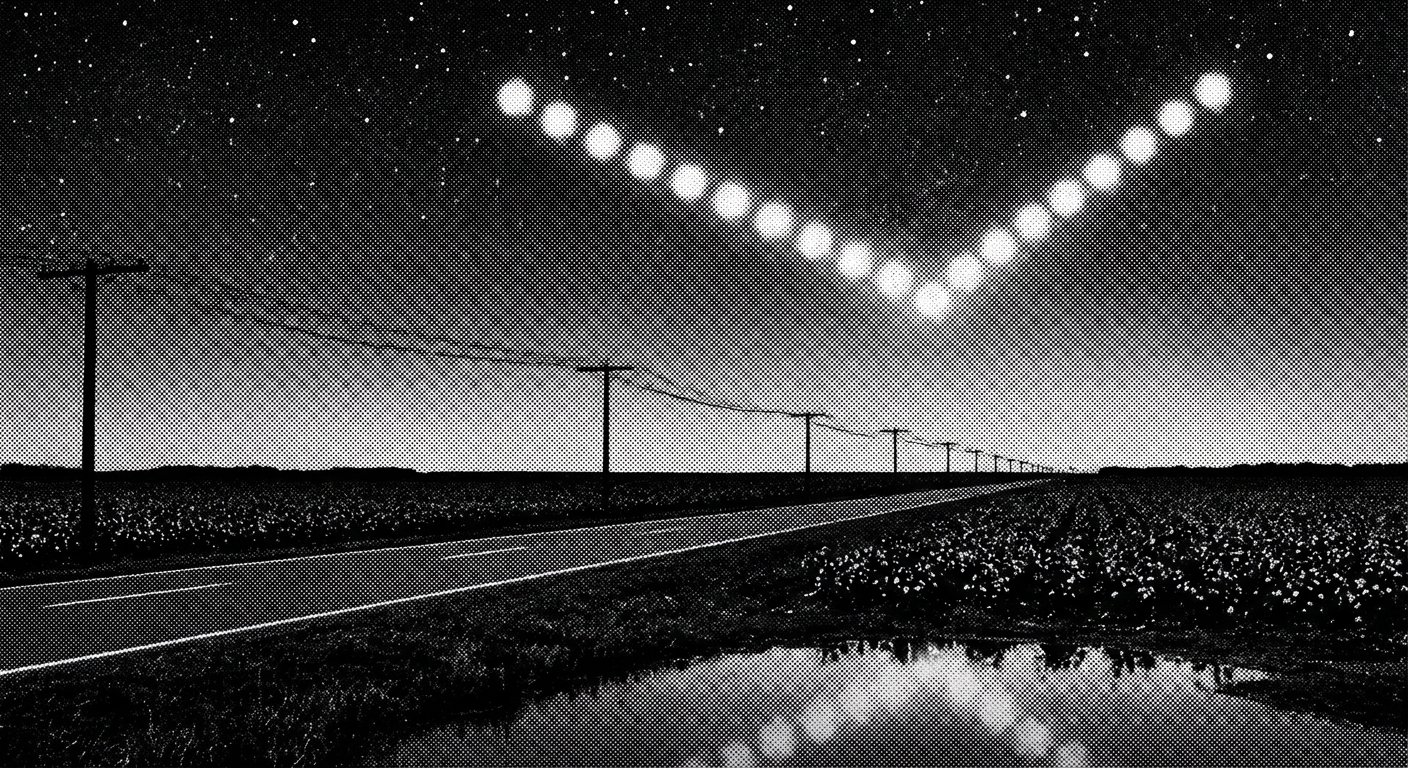
On August 30, 1951, 18-year-old Carl Hart Jr. is lying on his back in his yard when the lights pass over. He runs inside, grabs his Kodak 35mm camera, sets the aperture and shutter speed, and waits. The lights return. He photographs them five times across the next two hours. The developed images show V-shaped light formations against a dark sky, consistent with the professors' descriptions.
Project Blue Book investigator Captain Edward Ruppelt -- who later calls the Lubbock case one of the most significant he encountered -- initially classifies the photographs as authentic and the overall case as "Unknown." The final report, however, attributes the lights to nighthawks reflecting the newly installed city lights. The four professors, who know Texas wildlife, reject this explanation categorically.
First-Hand Accounts
“The lights were a bluish-white color, arranged in a rough semicircle. They moved from north to south at a speed that I estimated as many times faster than any conventional aircraft I have seen. There was no sound whatsoever. When I first saw them I thought they might be birds, but birds reflecting city lights would not produce a uniform, steady bluish-white glow -- they would flicker as they flapped. These lights were steady.”
W.I. Robinson, Ph.D.
Professor of Geology, Texas Technological College
Location: Residential backyard, Lubbock, Texas
Date: August 25, 1951 and multiple subsequent nights
Source: Robinson, W.I. (1951). Statement to Project Blue Book investigators. September 1951. Blue Book files, National Archives.
“I am an engineer. I approach problems empirically. We observed the objects on multiple occasions and attempted systematic measurement. The angular velocity was inconsistent with bird flight at any reasonable altitude. The luminosity was intrinsic -- not reflective -- and remained constant throughout each pass. I have examined the nighthawk explanation and it does not fit the evidence.”
A.G. Oberg
Professor of Chemical Engineering, Texas Technological College
Location: Residential backyard, Lubbock, Texas
Date: August 25, 1951 and subsequent nights
Source: Oberg, A.G. (1951). Statement to Project Blue Book investigators. September 1951. Blue Book files.
“I was lying on my back looking at the sky when the lights came over. I ran inside for my camera. I knew from seeing them the first time what exposure to set. When they came back, I shot them. I have heard people say I faked the photographs. I did not. The lights were real, they passed over my house, and I photographed them as they were.”
Carl Hart Jr.
College freshman; photographer
Location: Residential backyard, Lubbock, Texas
Date: August 30, 1951
Source: Hart, C. Jr. (1951). Interview with Life magazine investigators. 1952. Also: Project Blue Book files.
“The professors were among the most reliable witnesses I encountered in three years of UFO investigation. Their scientific training and their systematic observation methods produced unusually precise data. I was unable to explain what they saw. The Hart photographs were examined by a professional photo analyst who found no evidence of fabrication. The case troubled me.”
Captain Edward J. Ruppelt (USAF)
Head of Project Blue Book; investigated the case personally
Location: Wright-Patterson AFB (investigation base)
Date: 1952 (investigation); 1956 (published account)
Source: Ruppelt, E.J. (1956). The Report on Unidentified Flying Objects. Doubleday.
“The Lubbock lights were almost certainly lesser nighthawks. These birds congregate in large numbers in late summer in the Lubbock area and fly in irregular formations. The city had just installed new mercury vapor street lights, which produce the bluish-white glow the witnesses describe. The birds' white wing patches would reflect this light effectively.”
Dr. Donald Menzel
Harvard astronomer; Air Force consultant
Location: Harvard University
Date: 1953
Source: Menzel, D.H. (1953). Flying Saucers. Harvard University Press.
The Evidence Record
Carl Hart Jr. photographs -- five exposures (August 30, 1951)
Five photographs taken by 18-year-old Carl Hart Jr. with a Kodak 35mm camera on the night of August 30, 1951. The images show V-shaped formations of light against a dark sky. The photographs were examined by Life magazine photo analysts, U.S. Air Force investigators, and Project Blue Book's photo consultant -- no evidence of tampering, double exposure, or staged lighting was detected. Hart's exposure settings, timing, and camera position were verified by investigators.
Chain of Custody
Hart personal prints -> Lubbock Avalanche-Journal -> Life magazine -> Project Blue Book photo analysis -> National Archives
Texas Tech professors' systematic observation logs
The four professors conducted organized sky-watch sessions over several weeks, documenting times, headings, angular velocities, and estimated altitudes for each formation. Their notes were submitted to Project Blue Book as part of the formal investigation. The precision and consistency of the data across multiple observers was noted by Captain Ruppelt as exceptional.
Chain of Custody
Professors' personal notes -> submitted to USAF investigators -> Project Blue Book files -> National Archives
Project Blue Book case file -- Lubbock Lights
The complete Project Blue Book investigation file, initially classified "Unknown" and later revised. The file includes Ruppelt's personal notes, photo analysis reports, witness statements, and the final report attributing the lights to nighthawks. The discrepancy between the initial Unknown classification and the final nighthawk explanation is documented within the same file.
Chain of Custody
Project Blue Book -> declassified 1976 -> National Archives, Record Group 341
Government & Military Actions
Project Blue Book's investigation of the Lubbock Lights was one of its most extensive for any single series of events. Captain Ruppelt personally visited Lubbock, interviewed all four professors, and examined the Hart photographs. His initial assessment was that the case could not be explained. The final Blue Book report nonetheless attributed the lights to lesser nighthawks reflecting the city's new mercury vapor street lamps -- an explanation that satisfied the Air Force's leadership but not the witnesses, who maintained their objections until the end of their lives.
Official Timeline
August 25, 1951
First sighting by four Texas Tech professors. Three formations in quick succession.
Source: Witness statements, Project Blue Book files.
August 30, 1951
Carl Hart Jr. photographs five separate formations over approximately two hours.
Source: Hart, C. (1951). Project Blue Book files.
September 1951
Story breaks in Lubbock Avalanche-Journal. Photographs published. National attention follows.
Source: Lubbock Avalanche-Journal, September 1951.
Late 1951
Project Blue Book dispatches Captain Ruppelt to Lubbock. Professors interviewed, photographs analyzed.
Source: Ruppelt, E.J. (1956). The Report on Unidentified Flying Objects.
1952
Life magazine publishes comprehensive investigation. Photo analysis finds no evidence of fabrication.
Source: Life magazine, April 7, 1952.
1952
Project Blue Book officially attributes lights to lesser nighthawks reflecting city lights. Professors dispute.
Source: Project Blue Book final report on Lubbock Lights.
Declassified Documents
Project Blue Book Lubbock Case File
1951--1952 (declassified 1976)
Full investigation including Ruppelt's personal notes, photo analysis, and final classification. Shows the investigator's own uncertainty despite the official nighthawk conclusion.
USAF Photo Analysis Report -- Hart Photographs
1952
Official Air Force photographic analysis finding no evidence of manipulation or fabrication in the Hart photographs.
Alternative Explanations Examined
Claim 1
“The lights were lesser nighthawks (Chordeiles acutipennis), which congregate in late summer in West Texas and reflect city lights on their distinctive white wing patches.”
Accounts For
The semicircular formation shape (nighthawks fly in loose groups), the bluish-white color (consistent with mercury vapor street lamp reflection on white feathers), and the relatively short observation time (birds move quickly).
Fails to Explain
The four professors' specific objection that the light was intrinsic, not reflective -- nighthawk feathers would flicker as the birds flapped, but witnesses described steady luminosity. The angular velocity recorded by the professors, which they calculated as too high for any bird at any reasonable altitude. Why Carl Hart Jr., a Texas native, would not recognize nighthawks passing over his house. The five separate formations Hart photographed over two hours.
Skeptical Voices
“Lubbock had just installed mercury vapor street lighting when the sightings began. Lesser nighthawks are extremely common in that region in late summer. The white wing patches of the male nighthawk are large and conspicuous. Under the right angle of illumination they would glow a bluish-white. The professors were scientists, not ornithologists, and may not have recognized what they saw.”
Donald Menzel
Harvard astronomer; Air Force consultant
Source: Menzel, D.H. (1953). Flying Saucers. Harvard University Press.
“The nighthawk explanation is entirely plausible. Lesser nighthawks do form large aggregations. The conditions in Lubbock in August 1951 -- new city lighting, warm evenings drawing insects -- are exactly what attracts them. The professors made a natural error in an unfamiliar context.”
James McGaha
Astronomer; retired USAF pilot
Source: McGaha, J. (2011). Skeptical Inquirer analysis of classic UFO cases.
Chronology of Events
August 25, 1951 -- 9:20 p.m.
Late August 1951
August 30, 1951
September 1951
Late 1951
1952
1952
1956
Credibility Analysis
Witness Count & Quality
STRONG -- The initial witnesses were four academics with scientific training and professional reputations at stake. They conducted systematic rather than casual observations. The independent Hart photographs add a second category of witness.
Physical Evidence
MODERATE -- Five authenticated photographs. No physical samples. Photo analysis found no manipulation, but photographic evidence alone cannot establish the nature of the objects.
Account Consistency
STRONG -- The four professors' accounts are consistent with each other and with the Hart photographs. All four maintained their description and their rejection of the nighthawk explanation throughout their lives.
Independent Verification
MODERATE -- The Hart photographs independently corroborate the professors' descriptions. Multiple other Lubbock residents reported similar formations in the same period, though their accounts are less formally documented.
What We Know
- ✓
Four Texas Technological College professors simultaneously observed multiple formations of luminous objects over Lubbock on August 25, 1951.
- ✓
The objects were observed on multiple additional nights over the following weeks, with systematic measurements recorded.
- ✓
Carl Hart Jr. independently photographed five formations on August 30, 1951, and the photographs were found authentic by Air Force and independent analysts.
- ✓
Captain Edward Ruppelt, head of Project Blue Book, initially classified the case as Unknown and considered it among the most significant he investigated.
- ✓
All four professors specifically disputed the nighthawk explanation on scientific grounds, noting the light was intrinsic rather than reflective and the speed was inconsistent with bird flight.
- ✓
Ruppelt later wrote that the true explanation for the Lubbock Lights was known to Project Blue Book but was never publicly released.
Remains Unexplained
- ?
The true basis for Ruppelt's statement that the explanation was known but never released.
- ?
Whether the angular velocity measurements recorded by the professors can be reconciled with any known natural phenomenon.
- ?
Why Hart, a native Texan familiar with local wildlife, did not recognize nighthawks if that was the explanation.
- ?
The specific intrinsic luminosity described by the professors -- nighthawk feathers reflect, not emit, light.
Sources & Further Reading
The Report on Unidentified Flying Objects
Captain Edward J. Ruppelt · 1956
The head of Project Blue Book's account of the Lubbock investigation. Ruppelt hints that the real explanation was never released publicly.
Project Blue Book Files -- Lubbock Lights
U.S. Air Force · 1951--1952
Declassified investigation file including witness statements, Ruppelt's notes, photo analysis, and the final nighthawk conclusion. National Archives, Record Group 341.
Life Magazine -- "Have We Visitors from Space?"
Life Magazine staff · 1952
Comprehensive early investigation including independent photo analysis and interviews with the professors. One of the first major mainstream media examinations of the Lubbock case.
Flying Saucers
Donald H. Menzel · 1953
Primary source for the nighthawk explanation. Menzel presents the most detailed argument for the conventional interpretation.