59 SECONDS OF FILM SHOW LARGE BIPEDAL PRIMATE AT BLUFF CREEK -- AUTHENTICITY DISPUTED FOR 57 YEARS
Anthropologists confirm gait inconsistent with human locomotion -- multiple suit claims never corroborated -- footprints cast by anthropologist establish separate evidence record
BLUFF CREEK, CALIF. -- October 20, 1967 -- First reported: October 20, 1967
Date
October 20, 1967 -- approximately 1:15 p.m. PST
Location
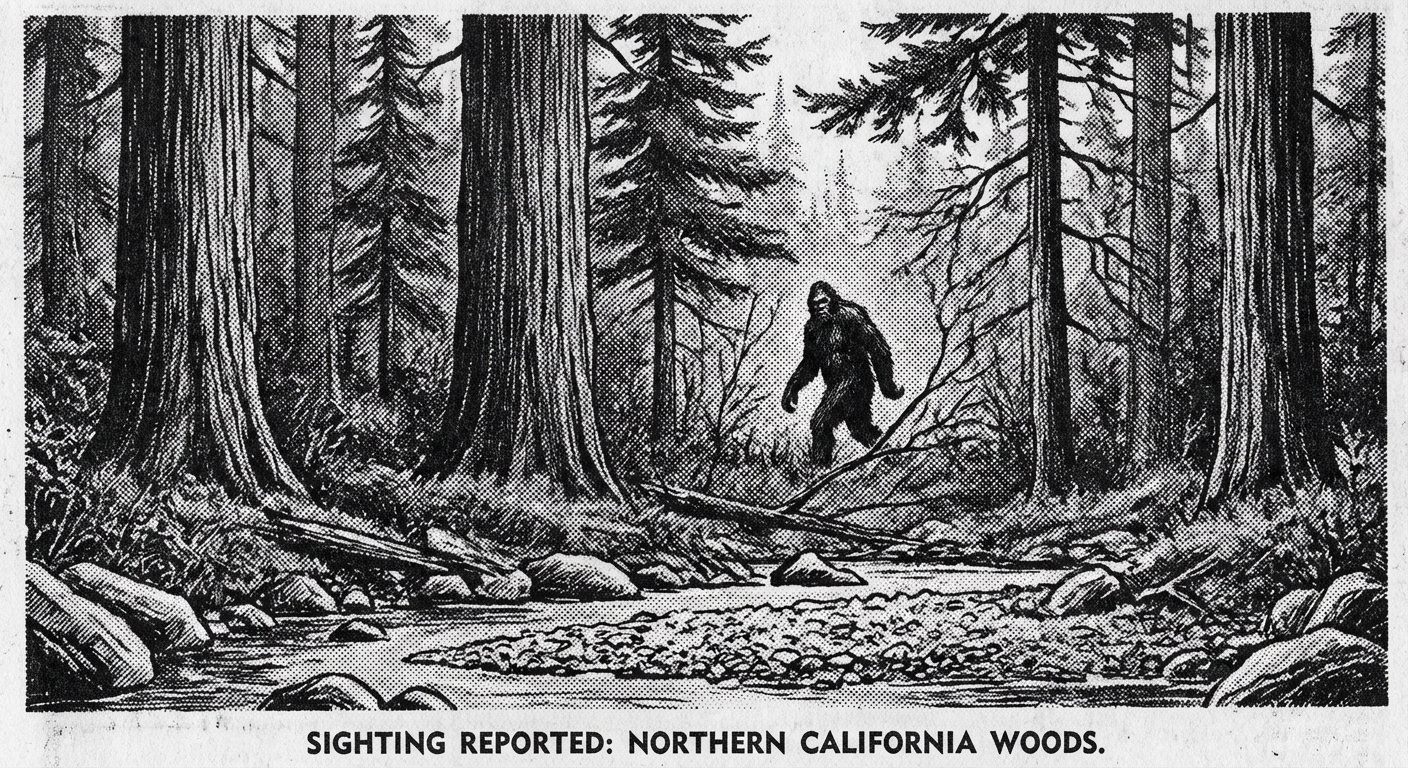
Bluff Creek sandbar, Six Rivers National Forest, Humboldt County, California
Witnesses
2 primary (Roger Patterson, Robert Gimlin); footprint cast witness Bob Titmus arrived within days
Evidence Types
PHOTOGRAPHIC, PHYSICAL
Official Explanation
No official government explanation; skeptics assert man in a suit
Current Status
No costume has been produced; no credible claimant has provided corroborating evidence; biomechanics analysis remains split
Roger Patterson and Robert Gimlin are on horseback along the gravel bars of Bluff Creek in the Six Rivers National Forest on the afternoon of October 20, 1967. They are searching for Bigfoot. Patterson, a rodeo rider who has spent months preparing for this expedition, has his 16mm Cine-Kodak camera on his saddle.
As their horses round a bend, a large, dark figure is crouching near a log jam at the creek's edge approximately 80 to 100 feet away. The horses rear. Patterson's horse throws him. He scrambles to his feet, pulling the camera from its bag, and runs toward the figure while filming.
The subject -- approximately seven feet tall, heavily built, covered in dark hair -- stands upright and walks away from the camera with a distinctive swinging stride. It turns once to look back at Patterson. The footage lasts 59.5 seconds before the subject disappears into the tree line.
Gimlin remains on horseback with a rifle across his saddle, watching the tree line. He and Patterson do not pursue into the trees. The subject does not charge, threaten, or return. When both men are certain it has gone, they examine the ground. Footprints. Clear, deep prints in the gravel sand, each approximately 14.5 inches long.
They spend several hours at the site, measuring and photographing the tracks. Within days, experienced tracker Bob Titmus arrives and spends three days casting and documenting the footprints. The film is developed and examined. Frame 352 -- in which the subject turns and looks directly at the camera -- becomes one of the most analyzed images in the history of paranormal investigation.
First-Hand Accounts
“As my horse came around the log, I saw it crouching by the creek. My horse threw me. I got up, got the camera rolling, and ran toward it. It walked away from me -- it never ran, it walked. It turned and looked right at me. I have never seen anything like it in my life and I have spent a lot of time outdoors. It was not a man in a suit.”
Roger Patterson
Rodeo rider; author of Do Abominable Snowmen of America Really Exist? (1966)
Location: Bluff Creek sandbar, Six Rivers National Forest
Date: October 20, 1967
Source: Patterson, R. (1967). Interview with researcher John Green. October 1967.
“I had my rifle out and I was watching the tree line. Roger was running and filming. The creature walked away naturally, like a person but bigger. When it turned and looked at us, it was not frightened -- it seemed curious. I could see the muscles moving under the fur. I have never said I believe this was an extraterrestrial or a supernatural being. I believe it was an animal. A real one.”
Robert Gimlin
Rancher and experienced horseman
Location: Bluff Creek sandbar
Date: October 20, 1967
Source: Gimlin, R. (2004). Interview with Crypto Four Corners. Also multiple subsequent interviews in which Gimlin has maintained his account unchanged.
“The walk of the creature in the film shows a specific pattern of locomotion that does not correspond to normal human walking. The stride length, body rotation, and arm swing are all atypical. To fake this motion convincingly in 1967, in a costume, without advance preparation -- I consider this highly improbable.”
Dr. Dmitri Donskoy
Chief of the Department of Biomechanics, USSR Central Institute of Physical Culture
Location: Moscow, USSR
Date: 1967--1968 (analysis)
Source: Donskoy, D. (1968). Analysis of the Patterson film gait. Published in Soviet physical culture literature; cited by multiple cryptozoology researchers.
“I was the man in that suit. Roger Patterson hired me. The suit was made by Philip Morris, a costume maker in North Carolina. Patterson paid me $1,000. I have been living with this secret for almost 40 years.”
Bob Heironimus
Yakima, WA resident; claimed to be the man in the suit
Location: Yakima, WA
Date: 2004 (public claim)
Source: Heironimus, B. (2004). Interviews with Greg Long. Cited in Long, G. (2004). The Making of Bigfoot. Prometheus Books.
The Evidence Record
Patterson-Gimlin film -- 59.5 seconds, 16mm Kodak 4-X Reversal
The primary evidence. Approximately 59.5 seconds of 16mm film shot on Kodak 4-X Reversal stock at approximately 24 frames per second. Frame 352, showing the subject in near-profile looking back at the camera, has been analyzed by anthropologists, primatologists, biomechanics researchers, costume designers, and digital analysts over 57 years. No consensus on authenticity exists. The original film was held by Patterson until his death in 1972, then by his wife, and is now reportedly in private hands.
Chain of Custody
Patterson -> developed at a Yakima film lab -> sent to American National Enterprises for production -> copies made -> original reportedly sold to private collector
Bluff Creek footprint casts (October 1967)
Patterson and Gimlin cast some of the prints in plaster immediately after the encounter. Experienced tracker Bob Titmus arrived within days and cast additional prints with greater expertise. Titmus reported approximately 1,089 feet of trackway across the sandbar. Anthropologist Grover Krantz subsequently analyzed the prints and noted dermal ridges -- parallel skin patterns consistent with primate feet -- which he argued could not be fabricated by the available methods.
Chain of Custody
Patterson and Gimlin first casts -> Titmus professional casts -> Krantz analysis -> multiple specimens in private research collections and public display
Biomechanics analysis by Dr. Jeff Meldrum
Idaho State University professor Dr. Jeff Meldrum, a specialist in primate locomotion, has published peer-reviewed analysis of both the film and the footprint casts. His assessment is that the gait pattern, foot anatomy, and dermal ridges are inconsistent with human fabrication and consistent with an unknown primate with a locomotion pattern adapted for a plantigrade biped of substantially greater mass than a human.
Chain of Custody
Academic analysis published in peer-reviewed journals and in Meldrum, J. (2006). Sasquatch: Legend Meets Science. Forge Books.
Government & Military Actions
No U.S. government agency has formally investigated the Patterson-Gimlin film or the Bluff Creek footprints. The FBI was reportedly contacted in the early 1970s and declined to examine the film. The U.S. Army Corps of Engineers produced a Bigfoot assessment in 1975 that concluded the footprints were consistent with a large unknown primate, though this was a peripheral finding in a larger Northwest environmental study. The film itself has been examined by multiple academic institutions without official government sponsorship.
Official Timeline
October 20, 1967
Patterson and Gimlin encounter the subject at Bluff Creek. Film is shot. Footprints measured and photographed.
Source: Patterson and Gimlin witness statements.
October 21--24, 1967
Bob Titmus arrives. Conducts professional tracking and casts footprints over three days.
Source: Titmus, B. (1967). Field notes.
November 1967
Film is first shown to scientific audiences including anthropologists at the University of British Columbia.
Source: Multiple academic records.
1968
Soviet biomechanics expert Dr. Donskoy analyzes the film and finds the gait atypical of human locomotion.
Source: Donskoy analysis, Soviet physical culture publications.
April 22, 1972
Roger Patterson dies of Hodgkin's lymphoma, age 38, maintaining his account to the end.
Source: Gimlin, R. (1999). Interview with John Green.
2004
Bob Heironimus publicly claims to have worn the suit. Greg Long publishes The Making of Bigfoot. Heironimus fails to identify the specific costume maker credibly; no suit is ever produced.
Source: Long, G. (2004). The Making of Bigfoot. Prometheus Books.
Declassified Documents
U.S. Army Corps of Engineers -- Bigfoot assessment (1975)
1975
Peripheral acknowledgment in an environmental study that the footprint evidence is consistent with an unknown primate. Not a dedicated investigation.
Alternative Explanations Examined
Claim 1
“The figure in the film is a man in a gorilla or Bigfoot suit, constructed by costume maker Philip Morris and worn by Bob Heironimus.”
Accounts For
The simplest explanation for the film's content. Both Morris and Heironimus have made public claims of involvement.
Fails to Explain
Neither Morris nor Heironimus has ever produced the suit. Costume makers who have analyzed the film -- including those at Disney and Stan Winston Studio -- have stated they do not believe any 1967 costume technology could replicate the muscle movement visible in the film. Gimlin has maintained a consistent, detailed account for 57 years with no credible evidence of deception. The footprint evidence -- including dermal ridges -- is separate from the film and would require an elaborate independent fabrication.
Claim 2
“The footprints were faked using carved wooden foot prosthetics, a technique documented in subsequent Bigfoot hoaxes.”
Accounts For
A mechanism for producing large, convincing footprints.
Fails to Explain
Dr. Krantz's and Dr. Meldrum's analyses of dermal ridges in the original casts, which they argue could not be produced by 1967 prosthetic technology. The 1,089 feet of trackway Titmus documented over three days, which would require a sustained and physically demanding hoax performance.
Skeptical Voices
“I made that suit. Roger Patterson called me and described what he wanted. I sent him a gorilla suit with modifications. I have been telling this story for years but no one listens.”
Philip Morris
Costume maker, Charlotte, North Carolina
Source: Morris, P. (2004). Various media interviews. Note: Morris's account contains inconsistencies about the suit's design that do not match the film.
“The film cannot be proven genuine or fake. The best scientific position is agnosticism. The burden of proof for a new primate species is very high, and the film alone does not meet it.”
Dr. David Daegling
Anthropologist, University of Florida
Source: Daegling, D. (2004). Bigfoot Exposed. Altamira Press.
Chronology of Events
October 20, 1967 -- 1:15 p.m.
October 20, 1967
October 21--24, 1967
November 1967
1968
April 22, 1972
2004
2006
Credibility Analysis
Witness Count & Quality
MODERATE -- Two witnesses whose accounts have been consistent for decades. Gimlin (the surviving witness) has never wavered. Multiple secondary witnesses to the footprint evidence.
Physical Evidence
STRONG for the footprints -- dermal ridges and trackway length provide independent evidence separate from the film. DISPUTED for the film -- genuine scientific disagreement exists about whether the gait and physique are consistent with a costumed human.
Account Consistency
STRONG -- Patterson and Gimlin's core accounts are consistent across all interviews from 1967 until Patterson's death in 1972. Gimlin has maintained the same account for 57 years.
Independent Verification
STRONG for footprints -- documented independently by Titmus and multiple academic researchers. DISPUTED for film -- academic community is split.
What We Know
- ✓
Roger Patterson and Robert Gimlin filmed an unknown subject at Bluff Creek on October 20, 1967.
- ✓
The film has been analyzed by costume designers, biomechanics specialists, anthropologists, and primatologists for 57 years without consensus on whether it depicts a human in a costume or an unknown primate.
- ✓
Footprints at the site were documented and cast independently by experienced tracker Bob Titmus and subsequently analyzed by academics who found evidence of dermal ridges.
- ✓
Multiple people have claimed to be the man in the suit, but none has produced a costume or credible corroborating evidence.
- ✓
Robert Gimlin has maintained his account without alteration for 57 years.
- ✓
Biomechanics experts including Soviet Dr. Donskoy and Idaho State's Dr. Meldrum have concluded the gait pattern is inconsistent with human locomotion.
Remains Unexplained
- ?
Whether the gait and physique visible in the film are achievable with 1967 costume technology.
- ?
The source of the dermal ridges found in the footprint casts.
- ?
Why no suit claimant has ever produced the physical costume.
- ?
The identity of the subject in Frame 352 of the Patterson-Gimlin film.
Sources & Further Reading
Sasquatch: Legend Meets Science
Dr. Jeff Meldrum · 2006
The most comprehensive scientific analysis of the Patterson-Gimlin film and footprint evidence by an Idaho State University anthropologist specializing in primate locomotion.
Bigfoot Exposed
Dr. David Daegling · 2004
Skeptical analysis by a University of Florida anthropologist. Argues for agnosticism rather than confirmation and examines the limits of what the film evidence can establish.
The Making of Bigfoot
Greg Long · 2004
The primary skeptical case, presenting the Heironimus and Morris claims. Widely criticized for inconsistencies in the claimants' accounts.
Do Abominable Snowmen of America Really Exist?
Roger Patterson · 1966
Patterson's pre-encounter book establishing his interest in the subject and his investigative approach. Important context for the expedition.